
Suchen
WONACH SUCHST DU?

Möglicherweise ist Ihnen aufgefallen, dass die Farben Ihres Bildschirms nach monatelanger täglicher Nutzung verblassen oder sich ungleichmäßige Flecken bilden. Dies kann bei jedem OLED-Display vorkommen, insbesondere wenn Sie stundenlang dasselbe Bild auf Ihrem Gerät anzeigen lassen. Wenn Sie ein OLED-Display besitzen, sollten Sie es regelmäßig überprüfen lassen. OLED-DisplaySie fragen sich vielleicht, warum manche Bildschirme länger halten als andere. Studien zeigen, dass OLED-Displays zwischen 20.000 und 100.000 Stunden halten können, während LCD-Bildschirme üblicherweise 30.000 bis 60.000 Stunden erreichen. Ihre Gewohnheiten, die Umgebung und die Pflege Ihres OLED-Displays spielen dabei eine Rolle. Überlegen Sie einmal, wie Sie Ihre OLED-Geräte täglich nutzen. Schon kleine Änderungen können die Lebensdauer Ihres OLED-Displays deutlich verlängern.
Um Bildspeicherung und Einbrennen zu vermeiden, sollten Sie auf Ihrem OLED-Display keine statischen Bilder anzeigen lassen.
Nutzen Sie den Dunkelmodus, um den Stromverbrauch zu reduzieren und die Lebensdauer Ihres Bildschirms zu verlängern.
Reinigen Sie Ihren OLED-Bildschirm regelmäßig mit einem Mikrofasertuch, um Bildschärfe und Leistung zu erhalten.
Schalten Sie Ihr Gerät aus, wenn Sie es nicht benutzen, damit es abkühlen kann und eine Überhitzung vermieden wird.
Stellen Sie die Helligkeit auf die empfohlenen Werte ein, um die Belastung des Displays zu reduzieren und seine Lebensdauer zu verlängern.
Aktivieren Sie die Pixel-Aktualisierungsfunktionen, um Bildspeicherung zu verhindern und eine gleichmäßige Helligkeit zu gewährleisten.
Verwenden Sie Überspannungsschutzgeräte, um Ihr OLED-Display vor elektrischen Schäden zu schützen.
Bewahren Sie Ihr Gerät an einem kühlen, trockenen Ort auf, um es vor Feuchtigkeit und Hitze zu schützen.
Nach längerer Anzeige desselben Bildes können auf Ihrem OLED-Bildschirm schwache Konturen oder Geisterbilder auftreten. Dieser Effekt, bekannt als Bildspeicherung, entsteht, wenn statische Bilder über Stunden auf dem Bildschirm angezeigt werden. Die organischen Verbindungen in OLED-Bildschirmen reagieren auf die ständige Lichteinwirkung mit ungleichmäßigem Verschleiß. Mit der Zeit führt dies zum Einbrennen, d. h. die Spuren werden dauerhaft und verschwinden nicht mehr. Wenn Sie Ihr Gerät häufig mit einem pausierten Video, einem Spielmenü oder einem Newsticker angezeigt lassen, erhöhen Sie das Risiko von Bildspeicherung und dauerhaftem Einbrennen. Solche Gewohnheiten können die Lebensdauer Ihres OLED-Displays verkürzen.
Sie können Ihre OLED-Bildschirme vor dem Einbrennen schützen, indem Sie Ihre Sehgewohnheiten ändern. Vermeiden Sie es, statische Bilder über längere Zeit auf dem Bildschirm anzuzeigen. Nutzen Sie Funktionen wie das automatische Ausblenden von Symbolleisten oder Navigationsleisten. Stellen Sie Ihr Gerät so ein, dass sich das Display bei Nichtgebrauch ausschaltet. Wechseln Sie regelmäßig Ihre Hintergrundbilder oder Inhalte. Diese kleinen Änderungen helfen, das Einbrennen von Bildern zu verhindern und das Risiko dauerhafter Einbrenneffekte zu reduzieren. Sie werden feststellen, dass Ihre OLED-Bildschirme deutlich länger heller und klarer bleiben.
Der Wechsel in den Dunkelmodus schont Ihre OLED-Bildschirme. Im Dunkelmodus bleiben mehr Pixel ausgeschaltet oder verbrauchen weniger Strom, wodurch die organischen Schichten weniger belastet werden. Das bedeutet, dass Ihr OLED-Display weniger Wärme erzeugt und weniger Energie verbraucht. Sie werden weniger Einbrenneffekte feststellen und das Risiko von Einbrennen verringern. Viele Nutzer empfinden den Dunkelmodus auch als angenehmer, insbesondere bei schwachem Licht. Ihre Augen werden es Ihnen danken und Ihre OLED-Bildschirme haben eine längere Lebensdauer.
Die meisten Geräte mit OLED-Bildschirmen bieten einen Dunkelmodus. Diese Einstellung finden Sie im Menü „Anzeige“ oder „Darstellung“. Aktivieren Sie den Dunkelmodus für Ihr Betriebssystem und die unterstützten Apps. Bei manchen Geräten können Sie den Dunkelmodus so einstellen, dass er nachts automatisch aktiviert wird. Sie können auch dunkle Hintergrundbilder und Designs auswählen. Diese Schritte helfen Ihnen, das volle Potenzial Ihres OLED-Displays auszuschöpfen und das Einbrennen von Bildern zu verhindern.
Die regelmäßige Reinigung Ihres OLED-Bildschirms trägt wesentlich zu seiner Bildschärfe und Leistungsfähigkeit bei. Staub, Fingerabdrücke und Schlieren können sich mit der Zeit ansammeln. Reinigen Sie Ihren Bildschirm daher regelmäßig mit schonenden Methoden. Beginnen Sie mit einem trockenen Mikrofasertuch, um Staub zu entfernen. Hartnäckige Schlieren lassen sich mit einem leicht angefeuchteten Mikrofasertuch entfernen. Verwenden Sie niemals Taschentücher oder Papiertücher, da diese die Oberfläche zerkratzen können. Vermeiden Sie aggressive Reiniger wie Alkohol oder ammoniakhaltige Produkte, da diese die Beschichtung des Bildschirms beschädigen können. Trennen Sie Ihr Gerät vor Beginn der Reinigung immer vom Stromnetz.
Reinigen Sie OLED-Bildschirme regelmäßig, um Staub, Schlieren und Fingerabdrücke zu entfernen.
Verwenden Sie zum Reinigen trockene oder leicht angefeuchtete Mikrofasertücher.
Um die Beschichtung des Bildschirms zu schützen, sollten Sie auf aggressive Reinigungsmittel wie Alkohol oder ammoniakhaltige Produkte verzichten.
Bitte verwenden Sie keine Taschentücher oder Papiertücher, da diese das Display zerkratzen können.
Um elektrische Probleme zu vermeiden, ziehen Sie vor der Reinigung den Netzstecker des Fernsehers.
Beginnen Sie mit einem trockenen Mikrofasertuch, um Staub zu entfernen, und verwenden Sie anschließend ein feuchtes Tuch für Fingerabdrücke oder Flecken.
Üben Sie beim Reinigen keinen Druck aus und sprühen Sie keine Flüssigkeit direkt auf den Bildschirm.
Der Reinigungsprozess ist genauso wichtig wie die verwendeten Werkzeuge. Sprühen Sie niemals Flüssigkeit direkt auf OLED-Bildschirme. Befeuchten Sie stattdessen zuerst das Tuch. Reinigen Sie die Bildschirme mit sanften, kreisenden Bewegungen und vermeiden Sie starken Druck. Dies schützt die empfindliche Oberfläche und verhindert Kratzer oder Abplatzungen der Beschichtung. Die folgende Tabelle zeigt, wie sich verschiedene Reinigungsmittel im Laufe der Zeit auf OLED-Bildschirme auswirken:
|
Reinigungsmethode |
Sicher für OLED? |
Wirksamkeit der Blendungsreduzierung |
Auswirkungen auf die Lebensdauer der Beschichtung |
|---|---|---|---|
|
Gämse + destilliertes Wasser |
Ja |
Hoch |
Neutral (keine messbare Erosion nach 12 Monaten) |
|
Mikrofasertuch + 70%iger Isopropylalkohol |
No |
Mäßig |
Schwerwiegend (bis zu 40 % Verlust der Antireflexionsschicht nach 20 Reinigungen) |
|
Baumwolllappen + Leitungswasser |
No |
Niedrig |
Mäßig (kristalline Ablagerungen erhöhen die diffuse Reflexion) |
Mit diesen schonenden Reinigungstipps sorgen Sie dafür, dass Ihre OLED-Bildschirme klar und farbintensiv bleiben. Außerdem vermeiden Sie dauerhaftes Einbrennen und verlängern die Lebensdauer Ihres Displays.
Sie können die Lebensdauer Ihres OLED-Displays verlängern, indem Sie Ihr Gerät ausschalten, wenn Sie es nicht benötigen. Viele lassen ihre Bildschirme den ganzen Tag eingeschaltet, selbst wenn sie sie nicht benutzen. Diese Angewohnheit führt dazu, dass die organischen Materialien im Display schneller altern. Wenn Sie Ihr Gerät ausschalten, geben Sie dem Bildschirm die Möglichkeit, sich zu erholen und abzukühlen. Diese einfache Maßnahme beugt Überhitzung vor, die den Alterungsprozess beschleunigen und das Risiko des Einbrennens erhöhen kann.
Tipp: Gewöhnen Sie sich an, Fernseher, Monitor oder Handy nachts oder bei längeren Pausen auszuschalten. Sie werden feststellen, dass Ihre Geräte kühler bleiben und mit der Zeit besser funktionieren.
Sie fragen sich vielleicht, ob der Standby-Modus Ihres Geräts ausreicht. Der Standby-Modus reduziert zwar den Stromverbrauch, aber der Bildschirm kann dennoch eine geringe Menge Energie verbrauchen. Einige Pixel können aktiv bleiben, insbesondere wenn das Gerät eine Uhrzeit oder Benachrichtigungen anzeigt. Mit der Zeit kann dies zu ungleichmäßigem Verschleiß führen und das Risiko des Einbrennens erhöhen.
Das vollständige Ausschalten Ihres Geräts beendet alle Aktivitäten auf dem Bildschirm. Dadurch kann sich das OLED-Display vollständig abkühlen und erholen. Wählen Sie „Ausschalten“ statt „Standby“, wenn Sie Ihr Gerät mehrere Stunden oder über Nacht nicht benutzen.
Standby-Modus: Schnelle Wiederaufnahme der Aktivität, bietet aber möglicherweise keinen vollständigen Schutz vor Einbrennen.
Strom aus: Ideal für längere Pausen, reduziert die Wärmeentwicklung und verringert das Risiko dauerhafter Bildschirmschäden.
Sie können Ihr OLED-Display schützen, indem Sie es häufiger ausschalten. Diese Gewohnheit, zusammen mit anderen guten Praktiken, trägt dazu bei, dass Ihr Bildschirm länger hält und besser aussieht.
Sie können die Lebensdauer Ihres OLED-Displays verlängern, indem Sie die Helligkeitseinstellungen anpassen. Hersteller empfehlen für Smartphones eine Helligkeit von 60 % bis 70 %. Bei Fernsehern sollten Sie 50 % bis 60 % anstreben. Höhere Helligkeitswerte führen zu einem schnelleren Verschleiß der organischen Materialien in OLED-Bildschirmen. Wenn Sie Ihr Gerät in einem dunklen Raum verwenden, reduzieren Sie die Helligkeit auf ein angenehmes Niveau. Diese einfache Anpassung schont die Pixel und trägt zu einer längeren Lebensdauer Ihres Displays bei.
Halten Sie die Bildschirmhelligkeit Ihres Smartphones zwischen 60 % und 70 %.
Stellen Sie die Helligkeit des Fernsehers auf 50 % bis 60 % ein.
Geringere Helligkeit in dunklen Umgebungen.
Die Helligkeit beeinflusst direkt die Lebensdauer Ihres OLED-Displays. Bei 100 cd/m² kann das Display bis zu 50.000 Stunden halten. Erhöht man die Helligkeit auf 300 cd/m², sinkt die Lebensdauer auf etwa 15.000 Stunden. Vermeiden Sie die maximale Helligkeit, außer es ist unbedingt notwendig. Die Anpassung der Helligkeit ist ein wichtiger Bestandteil der OLED-Wartung und beugt vorzeitiger Alterung vor.
Tipp: Eine geringere Helligkeit spart nicht nur Energie, sondern schont auch Ihre Augen und Ihren OLED-Bildschirm.
Moderne OLED-Displays verfügen über eine Pixel-Refresh-Funktion, die dem Einbrennen von Bildern entgegenwirkt. Technologien wie Sonys Pixel Shift verschieben das Bild minimal und verhindern so, dass statische Inhalte einbrennen. Die Panel-Refresh-Funktion kalibriert den Bildschirm nach einer festgelegten Anzahl von Betriebsstunden neu. Dieser Prozess gewährleistet eine gleichmäßige Helligkeit und gleicht den Pixelverschleiß aus.
Durch die Aktualisierungszyklen der Pixel wird die Bildqualität erhalten.
Pixel Cycling trägt zu einem gleichmäßigen Verschleiß des Bildschirms bei.
Marken wie LG bieten automatische Pixelaktualisierungsfunktionen an.
Führen Sie regelmäßig Pixelaktualisierungszyklen als Teil Ihrer OLED-Wartungsroutine durch. Der Pixel-Refresher von LG dauert etwa zehn Minuten und kann bis zu 90 % der sichtbaren Einbrenneffekte beseitigen. Integrierte Schutzfunktionen, einschließlich Pixelaktualisierungszyklen, machen moderne OLED-Displays widerstandsfähiger gegen Einbrennen. Verwenden Sie den Pixel-Refresher nach längeren Phasen mit statischen Inhalten oder wenn Sie leichte Einbrenneffekte bemerken.
Die Aktivierung eines Bildschirmschoners beugt ungleichmäßigem Verschleiß Ihres OLED-Displays vor. Wenn Sie Ihren Computer unbeaufsichtigt lassen, schützt ein herkömmlicher Bildschirmschoner den Bildschirm vor Einbrennen. Die Bildschirmdimmung und die automatische Abschaltung des Displays reduzieren zudem das Risiko von statischen Bildeinlagerungen.
Verwenden Sie Bildschirmschoner, wenn Sie Geräte im Leerlauf lassen.
Aktivieren Sie die Funktionen für Display-Timeout und Dimmung.
Die Wiedergabe von Videos im Vollbildmodus trägt zu einer gleichmäßigen Pixelnutzung bei. Dadurch wird das Einbrennen verhindert und die OLED-Wartung erleichtert. Vermeiden Sie es, Videos lange anzuhalten, da statische Bilder zu ungleichmäßigem Pixelverschleiß führen können.
Notiz: Die regelmäßige Verwendung von Bildschirmschonern und Vollbildvideos trägt zur Langlebigkeit Ihres OLED-Displays bei.
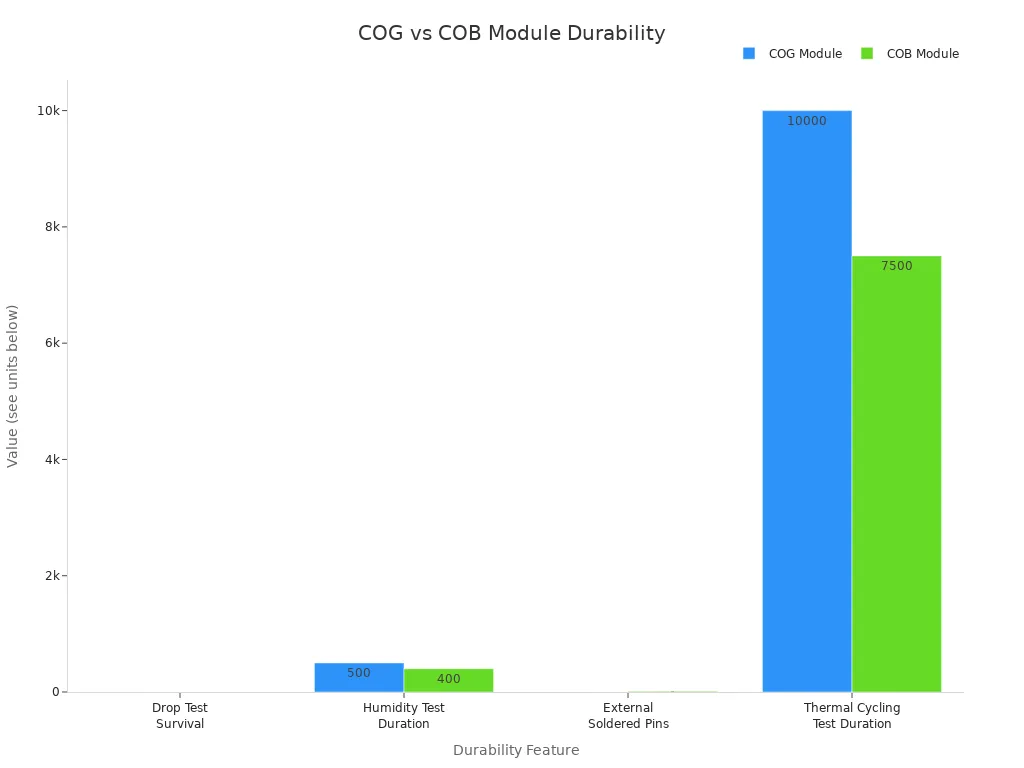
Wenn Sie ein Display mit erhöhter Langlebigkeit und einfacher Wartung wünschen, sollten Sie das folgende in Betracht ziehen: 1,3-Zoll-OLED-COG-ModulDieses Modul bietet robuste Eigenschaften für den Langzeiteinsatz. Die folgende Tabelle vergleicht seine Langlebigkeit mit der von COB-Modulen:
|
Besonderheit |
COG-Modul |
COB-Modul |
|---|---|---|
|
Falltest-Überleben |
1,5 m |
1,2 m |
|
Dauer des Feuchtigkeitstests |
500+ Stunden |
400 Stunden |
|
Externe Lötstifte |
0 |
10-15 |
|
Temperaturbewertung |
-40℃ bis 85℃ |
N / A |
|
Dauer des Temperaturwechseltests |
Mehr als 10.000 Stunden |
7.500 Stunden |
Sie sollten die Firmware Ihres OLED-Geräts stets auf dem neuesten Stand halten. Hersteller veröffentlichen Updates, um Fehler zu beheben und die Displayleistung zu verbessern. Diese Updates enthalten oft neue Funktionen, die Ihr Display vor Einbrennen und Nachleuchten schützen. Durch regelmäßige Updates steigern Sie die Effizienz Ihres Geräts und verlängern seine Lebensdauer. Sie können in den Geräteeinstellungen nach Updates suchen. Viele Geräte bieten automatische Updates an, sodass Sie keine wichtigen Verbesserungen verpassen.
Tipp: Stellen Sie Ihr Gerät so ein, dass es automatische Firmware-Updates empfängt. Dadurch erhalten Sie stets die neuesten Schutz- und Leistungsverbesserungen.
Firmware-Updates spielen eine entscheidende Rolle für die optimale Funktion Ihres Displays. Aktualisierte Software optimiert die Pixelaktualisierungszyklen und passt die Helligkeit an. Dies beugt ungleichmäßigem Pixelverschleiß vor und sorgt für ein scharfes Bild. Achten Sie auf Anzeichen von Alterung, wie z. B. Farbverblassung oder Einbrennen von Bildern. Sollten Sie solche Probleme feststellen, prüfen Sie, ob Updates verfügbar sind. Regelmäßige Updates tragen zur optimalen Funktion Ihres OLED-Displays bei.
Überspannungen können Ihr OLED-Display beschädigen. Schützen Sie Ihr Gerät daher mit Überspannungsschutzgeräten vor plötzlichen Spannungsspitzen. Diese Geräte absorbieren überschüssigen Strom und verhindern, dass er den Bildschirm erreicht. Überspannungsschutzgeräte sind einfach zu installieren und mit den meisten Fernsehern, Monitoren und Computern kompatibel. Sie sind im Elektronikfachhandel oder online erhältlich.
Schließen Sie Ihr OLED-Gerät an einen Überspannungsschutz an.
Wählen Sie einen Schalldämpfer mit hoher Joule-Zahl für besseren Schutz.
Alte Schalldämpfer sollten alle paar Jahre ausgetauscht werden.
Überspannungsschutz beugt elektrischen Schäden vor, die die Lebensdauer Ihres OLED-Displays verkürzen können. Vermeiden Sie es, Ihr Gerät bei Gewitter direkt an eine Steckdose anzuschließen. In Gebieten mit häufigen Stromausfällen ist Überspannungsschutz besonders wichtig. Ihr Gerät vor elektrischen Gefahren zu schützen, ist ein einfacher Schritt in Ihrer Wartungsroutine.
Notiz: Überspannungsschutzgeräte schützen nicht nur Ihr OLED-Display, sondern auch andere elektronische Geräte in Ihrem Haushalt.
Der 1,3-Zoll-OLED-COG-Modul Dieses Modul bietet fortschrittliche Funktionen für Langlebigkeit und Leistung. Dank der Chip-on-Glass-Technologie wird die Anzahl der externen Pins reduziert und die Zuverlässigkeit erhöht. Es ist beständig gegen extreme Temperaturen und Luftfeuchtigkeit und eignet sich daher für verschiedene Umgebungen. Auf dieses Modul können Sie sich für einen stabilen Betrieb und eine lange Lebensdauer verlassen.
|
Besonderheit |
Nutzen |
|---|---|
|
Chip-auf-Glass-Design |
Weniger verlötete Pins |
|
Breiter Temperaturbereich |
-40℃ bis 85℃ |
|
Hohe Feuchtigkeitstoleranz |
500+ Stunden |
|
Falltest-Überleben |
Bis zu 1,5 Meter |
Um Ihr OLED-Modul in optimalem Zustand zu halten, sollten Sie die folgenden Wartungshinweise beachten: Reinigen Sie den Bildschirm vorsichtig mit einem Mikrofasertuch. Vermeiden Sie aggressive Chemikalien und direkte Sonneneinstrahlung. Verwenden Sie einen Überspannungsschutz, um elektrische Schäden zu verhindern. Aktualisieren Sie die Firmware regelmäßig, sofern Ihr Gerät dies unterstützt. Diese Maßnahmen tragen dazu bei, die Lebensdauer Ihres OLED-Moduls zu maximieren und stets klare, brillante Displays zu genießen.
Aufbieten, ausrufen, zurufen: Regelmäßige Wartung und sorgfältige Handhabung gewährleisten, dass Ihr OLED-Display jahrelang hell und zuverlässig bleibt.
Schützen Sie Ihr OLED-Display vor direkter Sonneneinstrahlung und hohen Temperaturen. Sonnenlicht kann die Innentemperatur Ihres Geräts schnell erhöhen. Hohe Temperaturen führen dazu, dass die organischen Schichten in OLED-Bildschirmen schneller abgebaut werden. Bei extremer Hitzeeinwirkung kann es zu Helligkeitsverlust, Farbverschiebungen oder sogar zum Totalausfall kommen. Die folgende Tabelle zeigt, wie sich die Temperatur auf die Leistung von OLED-Displays auswirkt:
|
Beschreibung |
Auswirkungen auf OLED-Displays |
|---|---|
|
Hohe Temperaturen zersetzen organische Schichten |
Reduzierte Helligkeit und Farbgenauigkeit |
|
Organische Materialien sind bei erhöhten Temperaturen weniger stabil. |
Schnellerer Verschleiß und kürzere Lebensdauer |
|
Die Innentemperatur steigt in heißen Umgebungen |
Beschleunigter Verschleiß und Bedarf an Wärmemanagement |
Sie können Ihr OLED-Display schützen, indem Sie für ausreichende Belüftung sorgen. Platzieren Sie Ihr Gerät an einem gut belüfteten Ort. Vermeiden Sie es, Lüftungsschlitze abzudecken oder Ihr Gerät in der Nähe von Wärmequellen wie Heizkörpern oder Öfen aufzustellen. Achten Sie bei längerer Nutzung darauf, dass Rückseite und Seiten kühl bleiben. Eine gute Belüftung beugt Überhitzung vor und trägt zur Langlebigkeit des OLED-Bildschirms bei.
Feuchtigkeit kann Ihr OLED-Display beschädigen. Sie kann in den Bildschirm eindringen und elektrische Probleme oder Korrosion verursachen. Vermeiden Sie daher die Nutzung Ihres Geräts in feuchten Umgebungen. Wenn Sie in einer Gegend mit hoher Luftfeuchtigkeit leben, sollten Sie einen Luftentfeuchter in dem Raum aufstellen, in dem sich Ihr Gerät befindet. Feuchtigkeit kann die Lebensdauer Ihres OLED-Bildschirms verkürzen und die Bildqualität beeinträchtigen.
Bewahren Sie Ihr OLED-Gerät an einem trockenen, kühlen Ort auf. Verwenden Sie zum Transport eine Schutzhülle und legen Sie Silicagel-Päckchen bei, um Feuchtigkeit zu absorbieren. Vermeiden Sie die Lagerung im Keller oder Badezimmer. Diese Maßnahmen tragen dazu bei, optimale Bedingungen zu schaffen und die Langlebigkeit Ihres OLED-Bildschirms zu gewährleisten.
Verwenden Sie Ihr OLED-Display möglichst in Innenräumen. Im Freien ist Ihr Gerät Sonnenlicht, Hitze und Feuchtigkeit ausgesetzt. Diese Faktoren erhöhen das Risiko einer Beschädigung. Wenn Sie Ihr Gerät im Freien verwenden müssen, halten Sie es im Schatten und vermeiden Sie direkte Witterungseinflüsse.
Behandeln Sie Ihr OLED-Gerät sorgsam. Stellen Sie es auf eine stabile Unterlage, fern von Fenstern und Wärmequellen. Vermeiden Sie es, schwere Gegenstände darauf zu stapeln. Mit diesen einfachen Tipps zur Platzierung und Handhabung können Sie die Lebensdauer Ihres OLED-Bildschirms verlängern.
Tipp: Studien empfehlen, die Helligkeit zu steuern, statische Bilder zu vermeiden und optimale Bedingungen aufrechtzuerhalten, um die Lebensdauer von OLED-Displays zu maximieren.
Sie können die Lebensdauer Ihres OLED-Displays verlängern, indem Sie Produkte mit hochwertigen Materialien wählen. Hersteller verwenden eine Mischung aus organischen und anorganischen Materialien, um zuverlässige Bildschirme zu fertigen. Thermisch stabile Trägermaterialien und effiziente Dotierstoffe tragen dazu bei, den Verschleiß zu reduzieren und die Alterung zu verlangsamen. Anorganische Schichten sorgen für zusätzliche Stabilität und erhalten die Helligkeit des Bildschirms länger aufrecht. Verkapselungsverfahren schützen das Display vor Feuchtigkeit und Sauerstoff, die zu vorzeitigem Ausfall führen können. Strukturelle Designs, die die elektrische Belastung und die Wärmeentwicklung reduzieren, erhöhen ebenfalls die Stabilität der Geräte.
|
Materialart |
Auswirkungen auf die Lebensdauer |
|---|---|
|
Organische Materialien |
Thermisch stabile Wirtsmaterialien und Dotierstoffe mit hoher Quanteneffizienz minimieren Degradationsmechanismen. |
|
Anorganische Materialien |
Die verbesserte thermische und elektrochemische Stabilität trägt dazu bei, eine gleichbleibende Leuchtdichte über die Zeit aufrechtzuerhalten. |
|
Verkapselungsmethoden |
Schützt OLEDs vor Feuchtigkeit und Sauerstoff und verlängert so die Betriebsdauer erheblich. |
|
Tragwerksplanungen |
Innovative Designs reduzieren die elektrische Belastung und die Wärmeentwicklung, was zu stabileren Geräten führt. |
Bei der Auswahl eines OLED-Displays sollten Sie auf die Fertigungsstandards achten. Führende Hersteller befolgen strenge Qualitätskontrollen, um langlebige Produkte zu gewährleisten. Diese Standards beeinflussen alles, von der Lebensdauer bis zu den Reparaturkosten. OLED-Displays benötigen eine aufwendige Verkapselung zum Schutz der organischen Materialien, während LED-Displays einfachere Verfahren verwenden. Die folgende Tabelle vergleicht die wichtigsten Aspekte beider Displaytypen.
|
Aspekt |
OLED-Displays |
LED-Displays |
|---|---|---|
|
Lebensdauer |
Ungefähr 30.000-60.000 Stunden |
50.000-100.000 Stunden |
|
Abbau |
Der Abbau organischer Materialien führt zu einer Farbänderung |
Stabiler mit geringerer Degradation |
|
Fertigungskomplexität |
Erfordert komplexe Verkapselung |
Einfachere Fertigungsprozesse |
|
Reparaturkosten |
Kompletter Modulaustausch erforderlich |
Austauschbare Hintergrundbeleuchtungskomponenten |
|
Abschreibungsrate |
Behält nach drei Jahren 40-50 % seines Wertes. |
Behält nach drei Jahren 50-65 % seines Wertes. |
|
Energieverbrauch |
20-40 % weniger Leistung bei gemischten Inhalten |
Höherer Stromverbrauch |
|
Einbrennempfindlichkeit |
Hohe Anfälligkeit für das Einbrennen statischer Bilder |
Keine Einbrennprobleme |
|
Marktnachfrage |
Steigende Nachfrage nach Langlebigkeit |
Hohe Nachfrage nach Langlebigkeit |
Sie können die optimale Leistung Ihres OLED-Displays durch regelmäßige Firmware-Updates erhalten. Hersteller veröffentlichen Updates, um Fehler zu beheben und neue Funktionen hinzuzufügen. Diese Updates enthalten häufig Tools, die das Einbrennen von Pixeln verhindern und den Pixelverschleiß ausgleichen. Regelmäßige Updates verlängern die Lebensdauer Ihres Displays und sorgen für eine dauerhaft scharfe Darstellung.
Sie haben die Kontrolle über viele Einstellungen, die die Leistung Ihres OLED-Displays beeinflussen. Firmware-Updates ermöglichen Ihnen unter anderem die Anpassung der Helligkeit, die Aktivierung der Pixelaktualisierung oder das Festlegen von Bildschirmschonern. Durch die Nutzung dieser Funktionen können Sie häufige Probleme wie das Einbrennen von Bildern vermeiden. Prüfen Sie regelmäßig auf Updates und verwenden Sie die vom Hersteller bereitgestellten Tools.
Tipp: Stellen Sie Ihr Gerät so ein, dass es sich automatisch aktualisiert, damit Sie keine wichtigen Verbesserungen verpassen.
Sie können wählen Kundenspezifischer 1,54-Zoll-OLED-Bildschirm Passen Sie Ihr Display individuell an Ihre Bedürfnisse an. Zu den Anpassungsoptionen gehören Displaygröße, -form, -auflösung und Pixelkonfiguration. Wählen Sie die Schnittstelle, die am besten zu Ihrem Projekt passt, z. B. SPI, I2C, MIPI, LVDS oder HDMI. Einige Modelle bieten Touchpanel-Integration, verschiedene Deckglasoptionen und kundenspezifische Kabeldesigns. Mit diesen Funktionen gestalten Sie ein Display, das perfekt zu Ihrer Anwendung passt.
|
Anpassungsoption |
Beschreibung |
|---|---|
|
Displaygröße und -form |
Maßgeschneiderte Abmessungen und einzigartige Geometrien |
|
Auflösung und Pixelkonfiguration. |
Spezifische Pixeldichten und -anordnungen |
|
Schnittstellenoptionen |
Integration mit verschiedenen Kommunikationsprotokollen |
|
Touchpanel-Integration |
Hinzufügung von kapazitiven oder resistiven Touchscreens |
|
Abdeckglas |
Kundenspezifische Materialien, Dicken, Beschichtungen und optische Verbindungen |
|
FPC/Kabeldesign |
Kundenspezifische Längen, Pinbelegungen und Abschirmungen für flexible Leiterplatten |
|
Hintergrundbeleuchtung anpassen |
Für Hybriddisplays oder spezielle ästhetische Anforderungen |
|
Robustheit gegenüber Umwelteinflüssen |
Verbesserte Haltbarkeit bei extremen Temperaturen oder rauen Bedingungen |
Sie können die Langlebigkeit Ihres Displays verbessern, indem Sie speziell für anspruchsvolle Umgebungen entwickelte Funktionen auswählen. Optionen wie die Robustheitsprüfung schützen Ihr OLED-Display vor extremen Temperaturen und rauen Bedingungen. Spezielle Deckgläser und Beschichtungen bieten zusätzlichen Schutz vor Kratzern und Fingerabdrücken. Diese Verbesserungen tragen dazu bei, dass Ihr Display länger hält und auch unter anspruchsvollen Bedingungen eine bessere Leistung erbringt.
Notiz: Durch die Individualisierungsmöglichkeiten können Sie ein OLED-Display erstellen, das genau Ihren Anforderungen entspricht und dem täglichen Gebrauch standhält.
Sie können die Lebensdauer Ihres OLED-Bildschirms verlängern, indem Sie einige praktische Tipps befolgen. Halten Sie die Helligkeit moderat, variieren Sie die Inhalte und aktivieren Sie die Pixelaktualisierung. Nutzen Sie den Dunkelmodus und blenden Sie die Taskleiste automatisch aus, um die Belastung der Pixel zu reduzieren. Reinigen Sie Ihr Gerät regelmäßig und schalten Sie es aus, wenn Sie es nicht benutzen. Diese Tipps tragen zu einer langen Lebensdauer Ihres Bildschirms bei und sparen Ihnen Kosten für Ersatzteile. Investieren Sie in hochwertige Hardware und pflegen Sie Ihr Gerät, um optimale Ergebnisse zu erzielen. Genießen Sie jahrelang brillante Farben und gestochen scharfe Bilder.
Mit diesen Tipps holen Sie das Beste aus Ihrem OLED-Display heraus.
Vermeiden Sie statische Bilder. Nutzen Sie Bildschirmschoner und den Dunkelmodus. Reduzieren Sie die Bildschirmhelligkeit. Aktivieren Sie die Pixelaktualisierung. Schalten Sie Ihr Gerät aus, wenn Sie es nicht benutzen.
Stellen Sie die Bildschirmhelligkeit Ihres Smartphones auf 60 % bis 70 % ein. Bei Fernsehern empfiehlt sich eine Helligkeit von 50 % bis 60 %. Eine geringere Helligkeit verlängert die Lebensdauer des Displays und verringert das Risiko des Einbrennens.
Ja. Reinigen Sie den Bildschirm vorsichtig mit einem Mikrofasertuch. Vermeiden Sie aggressive Chemikalien. Sprühen Sie niemals Flüssigkeit direkt auf den Bildschirm. Durch die richtige Reinigung bleibt Ihr Bildschirm klar und wird vor Beschädigungen geschützt.
OLED-Displays können im Freien verwendet werden, sollten aber vor Sonnenlicht, Hitze und Feuchtigkeit geschützt werden. Um die Leistungsfähigkeit zu erhalten, sollte das Gerät im Schatten platziert und extreme Bedingungen vermieden werden.
|
Besonderheit |
Nutzen |
|---|---|
|
Robustheit |
Hält rauen Umgebungen stand |
|
Maßgefertigtes Abdeckglas |
Kratzfest |
|
Spezialbeschichtungen |
Reduziert Fingerabdrücke |
Die meisten OLED-Displays haben eine Lebensdauer zwischen 20.000 und 100.000 Stunden. Ihre Gewohnheiten, Einstellungen und die Umgebung beeinflussen die tatsächliche Lebensdauer.
Bitte lesen Sie weiter, bleiben Sie auf dem Laufenden, abonnieren Sie uns und wir heißen Sie herzlich willkommen, uns Ihre Meinung mitzuteilen.


Urheberrechte ©
© 2017 Guangdong Shengfeng Technology Co., Ltd. Alle Rechte vorbehalten
.Seitenverzeichnis
| Blog
| Xml | Datenschutzrichtlinie  NETZWERK UNTERSTÜTZT
 Sprache


 Rufen Sie uns an
:
Rufen Sie uns an
: